Here’s What a Fully Integrated Solar, Storage, and EV Charging System Looks Like — and How It Can Solve Your Business Challenges
Commercial and industrial (C&I) organizations today face a complex energy landscape. Utility rates are volatile, fleet electrification is accelerating, and ESG pressure from investors and customers continues to mount. For many businesses, effective energy management has shifted from a background operational task to a strategic priority.
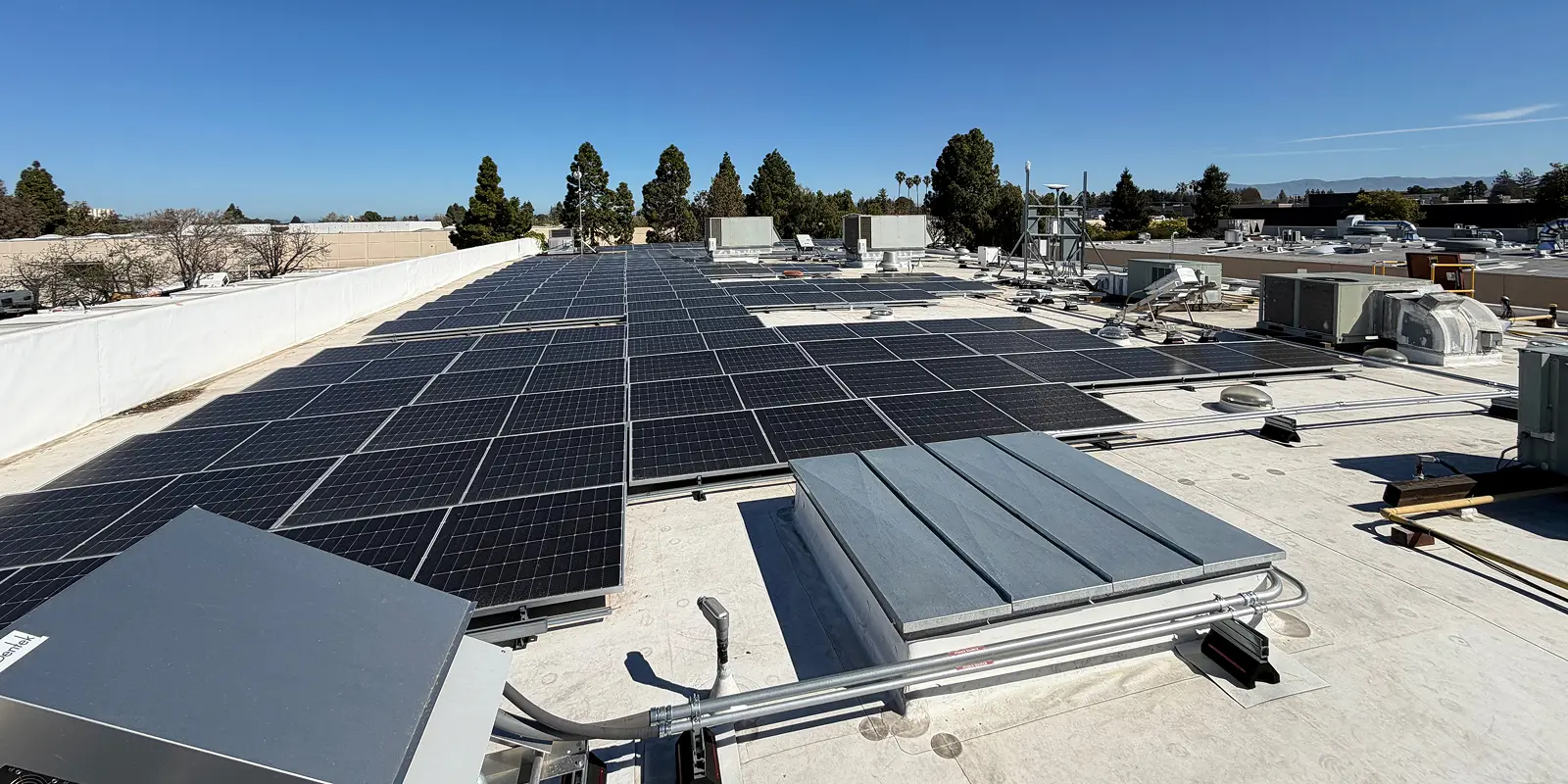
The PowerFlex Cleantech Integration Lab in Mountain View, California, provides a practical example for addressing these challenges. This fully operational office and warehouse facility is not a theoretical model or controlled environment; it’s a working site that demonstrates the integration of solar, battery energy storage, EV charging, and adaptive software into a unified system.
Learn more about our Clean Integration Lab and how implementing an integrated cleantech project can help achieve your business goals by transforming energy from a cost driver into a strategic asset.
Harnessing the Power of Multiple Clean Technologies & OEMs
At its core, the PowerFlex Cleantech Integration Lab showcases how multiple clean technologies can work in concert within a single facility. The system brings together three primary components:
- Rooftop solar arrays generate emissions-free electricity to help power daily operations and offset utility consumption
- EV charging infrastructure with Level 2 and DC Fast Chargers power employee and visitor electric vehicles
- Battery energy storage system (BESS) uses grid-following batteries to optimize energy usage and costs

What makes the Lab especially compelling is its vendor-agnostic architecture, integrating hardware from a wide range of original equipment manufacturers (OEMs). Components include:
- 82.5 kW DC Canadian solar panels
- CHINT CPS SCA50KTL-DO/US-480 inverter
- SolarEdge SE40KUS inverter
- Solectria PVI 50TL-480 inverter
- MA Sunny Tripower CORE1 50-US-41 inverter
- Socomec Sunsys L BESS (200 kW / 373 kWh)
- Socomec battery & power management
- Schweitzer Engineering Laboratories SEL 751 relay
- eGauge power meters
- 22 Level 2 EV Chargers and 2 DC Fast Chargers
By remaining hardware agnostic, PowerFlex cleantech deployments give customers the flexibility to choose equipment that best fits their technical and financial requirements without sacrificing system performance or cohesion.
Optimization Through Adaptive Software
Facilitating the interoperation of the multiple technologies and equipment OEMs within the Lab is the PowerFlex X™ platform, which serves as the site’s energy management system (EMS).
Instead of working in silos, PowerFlex X continuously monitors, controls, and co-optimizes onsite assets like solar arrays, battery energy storage, and EV chargers as a cohesive system. Using real-time data and predictive insights, it dynamically adjusts how energy flows across the facility in response to changing conditions and site loads.
- On the solar side, PowerFlex X leverages advanced monitoring capabilities, comparing actual solar production against modeled expectations based on irradiance and panel temperature. If output falls below expected levels, the system flags the issue immediately, enabling faster diagnostics and minimizing performance losses.
- Meanwhile, PowerFlex X orchestrates the BESS with regard to solar generation, facility consumption, and grid signals. The platform monitors battery state of charge and strategically dispatches stored energy to take advantage of cost-saving strategies and operational efficiencies.
- For EV charging, PowerFlex’s patented Adaptive Load Management (ALM) intelligently distributes power to chargers individually, in real time, taking into account site constraints, available power, driver schedules, and other inputs. The result is a flatter overall energy draw, avoiding peak demand fees and system overload.

All data is consolidated into a single, intuitive online portal that provides operators with comprehensive, real-time system metrics as well as historical reporting capabilities. PowerFlex also enables remote controls, such as setting batter setpoints, clearing faults, adjusting energy management strategies, and updating asset configurations.
The Bottom Line: Business Benefits of an Integrated Cleantech System
For C&I customers, PowerFlex's vendor-agnostic, integrated approach delivers a wealth of short- and long-term benefits:
1. Bill Reduction & Revenue Generation
One of the most immediate benefits is reduced energy costs and new revenue opportunities. By discharging the battery to power onsite loads during periods of high demand, customers can essentially “shave” their peak consumption and avoid demand charges from the utility — often one of the largest contributors to commercial electricity bills.
At the same time, PowerFlex X also enables time-of-use (TOU) arbitrage. Using forecasts and real-time data, the platform charges the battery with energy from the grid when utility rates are low (or with surplus solar energy) and then dispatches that energy to cover loads when rates are at their highest.
The system can also participate in demand response programs, allowing businesses to earn compensation by reducing or shifting energy use when the grid is under stress.
2. Cost-Managed EV Charging
An integrated cleantech approach with PowerFlex X turns EV charging from a costly infrastructure upgrade into a valuable asset that can attract EV-driving customers and employees to your business. With Adaptive Load Management®, sites can install significantly more charging ports — often 6 to 10 times more than conventional charging methods — without requiring major electrical upgrades. This not only reduces upfront costs but can also lower implementation expenses by as much as 60%, all while supporting more vehicles on site.
3. Visibility & Holistic Reporting
Equally important is the level of visibility and control the system provides. With granular, time-aligned data across every asset, from solar production to EV charging behavior to battery performance, operators gain a comprehensive understanding of how their energy system is functioning at any given moment. This data also supports holistic reporting by providing information on utilization, bill savings, emissions reductions, and more.
4. Compliance-Ready Telemetry
Lastly, the system’s detailed telemetry aligns with the requirements of many incentive programs, utilities, and regulatory frameworks. It also complies with typical interconnection and safety mandates and generates traceable data for studies, commissioning, and audits. Perhaps most importantly, this data is critical for measurement and verification purposes when fulfilling investor and ESG reporting requirements.
Experience the Future of Cleantech in Mountain View
The PowerFlex Cleantech Integration Lab is more than an office; it’s a proven blueprint for how commercial and industrial facilities can future-proof their energy infrastructure, decarbonize operations, and reduce operating expenses. By integrating solar, storage, EV charging, and adaptive software into a single, coordinated system, PowerFlex demonstrates what’s possible today — not in theory, but in practice.
If you’re planning a trip to Silicon Valley, there’s no better way to understand the impact of this approach than to see it firsthand. Contact the PowerFlex team to schedule a private, guided tour of the Cleantech Integration Lab in Mountain View and explore how an integrated energy strategy can transform your business.