

- 13 MW Solar Capacity
- 50 Acres Installation Site Size
- 18 Million kWh Annual System Production
- 20% Annual Utility Offset
13-MW Solar Array Enables Primo Brands to Power 20% of Operations at Poland Spring’s Largest U.S. Plant
Primo Brands is a leading provider of bottled water, perhaps best recognized in the Northeast for its iconic Poland Spring brand. The company’s bottling plant in Hollis, Maine, is its largest retail factory in the United States, acting as a critical hub for regional distribution.
Given its deep New England roots and its role as a major employer in the area, Primo Brands is committed to pursuing environmental stewardship and community investment alongside operational excellence.
Support High Power Demand at 24/7 Facility While Avoiding Price Volatility
The Hollis facility operates on a rigorous schedule, running 24 hours a day, seven days a week, and 363 days a year. An operation of this scale requires a massive and constant supply of electricity, creating several strategic hurdles for Primo Brands.
From a financial perspective, the company was exposed to volatile electricity rates, particularly during the summer months when energy demand and costs typically peak. From a sustainability standpoint, the company sought to materially reduce its greenhouse gas emissions and carbon footprint, making good on its commitment to supporting sustainable, healthy hydration.
Large-Scale Ground-Mounted Solar Installation Engineered for Maximum Energy Benefits
INSTALLATION TYPE
- Ground-Mounted Solar
INSTALLATION SIZE
- 13 MW
LOCATION
- Hollis, ME
ANNUAL ENERGY PRODUCTION
18 Million kWh
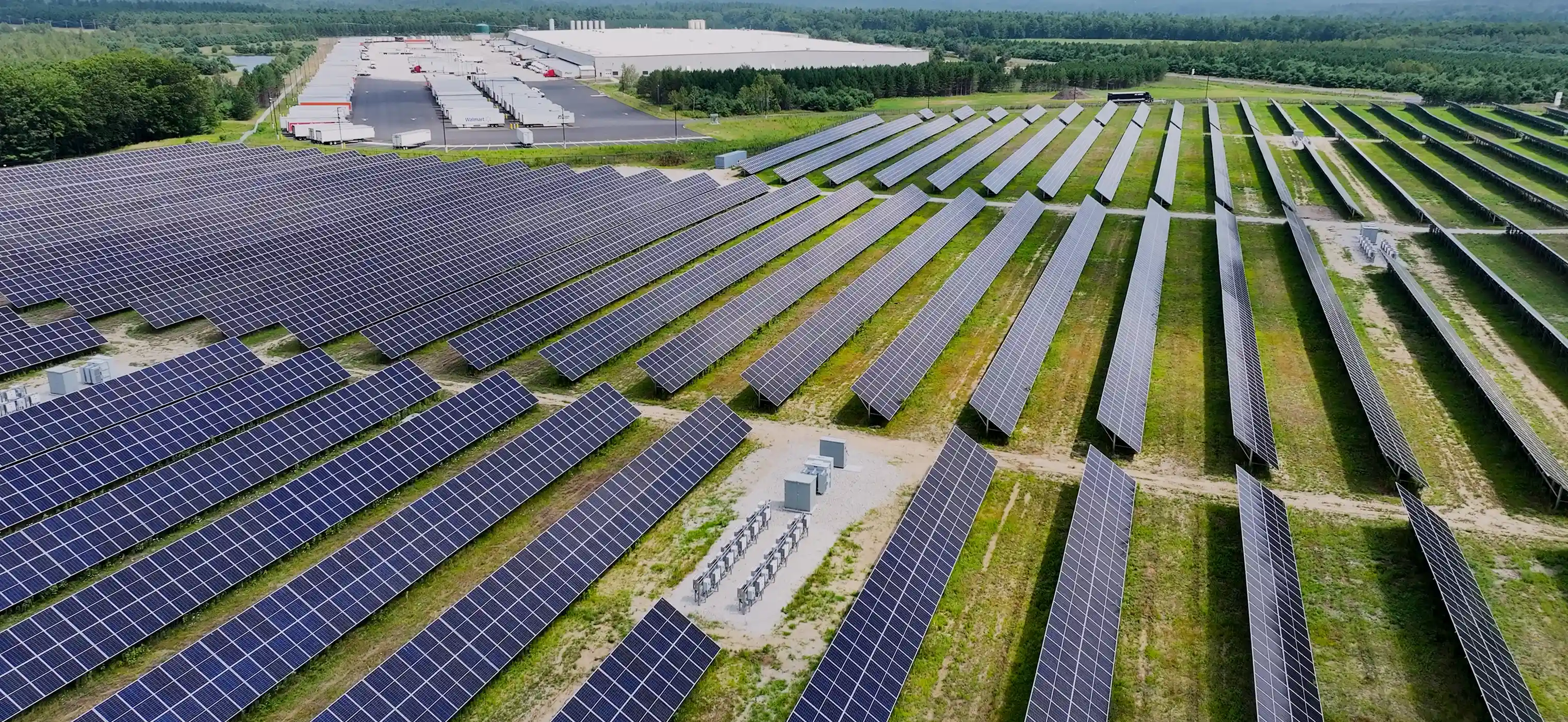
To address these complex needs, PowerFlex developed and constructed a 13-megawatt (MW) DC ground-mounted solar array spanning approximately 50 acres adjacent to the Hollis facility. This project represents Primo Brands’ largest solar installation in the United States and was made possible through a strategic partnership between PowerFlex and Onyx Renewables.
While PowerFlex led the engineering, procurement, and construction (EPC) aspects of the project, Onyx Renewables put up the necessary funding, structured a 25-year power purchase agreement (PPA), and provides ongoing asset management. This partnership allows Primo to benefit from long-term energy price stability without the burden of direct ownership, ensuring the project makes strong economic sense.
The system was engineered entirely behind the meter, a design choice that maximizes the energy available to the bottling plant by ensuring all electricity generated is consumed directly on site. Producing 18 million kilowatt-hours (kWh) annually, the array offsets 20% of the plant’s annual electricity needs, helping Primo reduce its reliance on the utility grid and limit its environmental impact.
To ensure the long-term health and safety of the massive solar array, PowerFlex adhered to the rigorous engineering standards set by Onyx Renewables. During the construction phase, the team performed comprehensive installation resistance testing on all cables to verify the integrity of the electrical system. Once the array was energized, PowerFlex conducted detailed infrared scans across the site to confirm there were no hot conducting materials or faulty connections. These quality assurance measures help ensure the system operates at peak efficiency while maintaining the highest safety standards for the facility and its employees.
“From the day we were permitted to start construction until the day we energized it, it was less than 16 months … That's a phenomenal track record for a project this size. So, we're very proud about the speed and the quality that PowerFlex ... provide[d] for our customer.”
Angie Daoud
Chief Operating Officer, Onyx Renewables
Today, Primo Brands enjoys a trifecta of benefits: enhanced cost stability through its PPA, a significant reduction in greenhouse gas emissions, and a strengthened relationship with the Hollis community. By investing in a quiet, emission-free energy source that respects the rural character of the town, Primo Brands and PowerFlex have set a new benchmark for how major manufacturers can lead the transition to a clean energy future.